Friday, 13 September 2013

Bringing Your Family History To Life

Tracing your family tree is an absorbing past time. Often it starts with a desire to find out how far back you can trace your family but along the way you will also start to root out other interesting information about your ancestors. You soon realise that they are more than a date in history.

There comes a point when you will want to gather all the information together and write it down.  However, then thoughts generally turn into how to make it more interesting than simply a set of dates.

Look at this example of a fictitious person called William MacDonald.

We could have an entry that said simply -

William MacDONALD was born on 7 November 1897 at 23 Example Street, Govan. He was the son of James MacDONALD and Mary RANKIN.  He married Janet FRASER on 22 June 1922 in Parish Kirk, Glasgow. He died on 17 August 1971 at the Royal Infirmary, Glasgow.  His home address then was 154 Sample Street, Glasgow.

However by adding in more detail on these bare details, we can build up the picture of William's life. 

We could write about his birth - 

William was the fifth of seven children born to James MacDONALD and Mary RANKIN.  He was born at the family home, 23 Example Street, Govan on 7 November 1897. 

Then by adding in some more details that we have from poor relief records, we can add in -

William was the fifth of seven children born to James MacDONALD and Mary RANKIN. He was born at the family home, 23 Example Street, Govan on 7 November 1897. The family lived in a tenement flat and were on the second floor in the left hand side flat.  

So we now have facts about William from his birth certificate, the 1901 census and poor relief records (from a later date) which described their flat. The next step that we can take is to add details about his life through putting the family into the historical context of the time. This can be done in a number of ways, for example by researching the area in which William lived and the wider social context of the times.

Mixing all these elements together we have -

William was the fifth of seven children born to James MacDONALD and Mary RANKIN. He was born at the family home, 23 Example Street, Govan on 7 November 1897. The family lived in a tenement flat and were on the second floor in the left hand side flat. 

For William and the rest of his family, the kitchen was the centre of activity in old tenement flats. William's family had two rooms. Beds, sink, coal bunker, cupboards, pulley, fireplace and cooking range would all be crammed into them. The cast iron kitchen range was standard in tenement buildings used both as a heating and a cooking tool. 

A large cast iron kettle normally stood on the hob keeping the water warm. Every effort was made to keep the fire alight over night, especially in winter. This was done by saving old tea-leaves and potato peelings, mixed with dross (coal dust) and cinders and placing them on the fire before going to bed.

Outside toilets were a common feature of Govan tenements until the late 19th century. Subsequently tenements were built with a toilet or renovated to include a shared water closet on each stair landing. Often too, the only running water was an outside tap that was used by all the residents.

By adding in these details, we are already bring William's world to life.  We can imagine how it would be to live in his home.  It can be quite daunting to build up these details however they do make the difference between a simple list of facts and an exciting and interesting book about our ancestors' lives.  

At Kin Tree we are not only experienced and qualified in genealogy but also in history so we have a wide knowledge base to build a picture of your family's past.  We have the experience and knowledge to draw together the genealogical facts and present them in a way that brings your family's story to life.  We are also experienced at printing family history books so we can present your book to a professional standard.

 If you have any questions on bring your family's story to life or on printing a family history book then please get in touch for a no obligation chat at:

kintree@ymail.com


Click on the links below to find us on 
facebook                    twitter


Friday, 6 September 2013

Great Digital Image Resource For Scotland

If you are looking for digital images relating to your Scottish family history then your first stop should be Scran


The Scran Trust hosts around 370,000 images, movies and sounds which come from archives, museums, galleries and the media on its website.  It's funded through the Scottish Government, subscriptions and sales of services.

The site is easy to navigate.  For the family historian there are lots of images available of local towns and cities.  Similarly, there are images of subjects such as occupations, migration and historic maps.  There are many other sections too or you can simply put in a straight forward search into their search engine.

This is only a very small glimpse of what is available on the site.  The best way to find out what is there is to go and look for yourself. Access can be gain in a number of ways. It's free to browse thumbnails of the images but to gain full access there are a number of was in which this can be done.

  • If you are a school pupil or student in Scotland, there is a good chance that you will have free access to the whole site. Check with your school, college or university librarian.
  • Local libraries often have accesses. This might be within the library itself and many have remote access from home.  Check with your local librarian for details of access.
  • Subscription - It is inexpensive to join Scran either for 6 months or a year.
  • Buy individual images.

The site has a wealth of material on Scottish life so it is of interest to not only family historians but to anyone with an interest in Scotland.  Why not give it a browse and if your local library does not give you access then why not ask them to subscribe to the site.

For more information on using online sites, please contact us for a free no obligation chat at:


kintree@ymail.com


Click on the links below to find us on 
facebook                    twitter


Friday, 30 August 2013

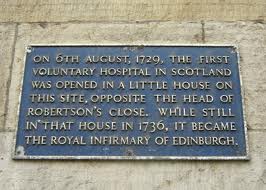
What Can Hospital Records Reveal About Your Ancestors?

Death certificates can reveal a tremendous amount of information about your ancestors but they need not be the final piece of the jigsaw.  If you are lucky then an obituary may appear or you may find a will but even without either of these things, there is a great way to look for further information.

If your ancestor died in hospital then it is worth investigating if there is a record of their hospital stay. Depending on the country in which you live there may be some restrictions on what you can access and how much time must have elapsed before you can access the records however it is always worth checking with the archivists for the latest information as data protection laws are often updated.  

So what information can you find? It will vary even within the same hospital - from the briefest of details perhaps regarding your ancestor's admission to hospital to full clinical notes or a post mortem.  The great news though is that even with the briefest of details, these can easily reveal some interesting facts and open up a new way to investigate a branch of your tree.

A good example of this was Edinburgh Royal Infirmary who on admission to the hospital, asked  patients for their "native place" or in other words, their place of birth.  This can be invaluable for those seeking to place their Irish ancestors as it would often name a town or at least a county.

It can often be a surprise to find ancestors admitted to hospital.  How did they afford to pay for their care if there was no free health care? However many hospitals were operated by subscriptions and were known as "free" or "voluntary" hospitals.  They received donations from rich individuals but also charities, churches and many work places and unions operated schemes where workers paid into a fund so that they could receive treatment if they needed it.  The work place contributions were particularly common within industries where there was a certain amount of danger and therefore there was more chance of accidents.

Hospitals were not always  in the immediate area in which your ancestors lived so if your relative died in hospital, you may find it is some distance from their home. This is usually because this was a hospital that was free or perhaps, the one to which their workplace or church subscribed.

It is important if you are going to approach a health archivist to be prepared.  They will need specific information on your ancestor in most cases.

They are not usually able to look for someone without details of when they were in the hospital as the information is not in a nice modern database where they can simply search for someone's name!

Also, think closely about what information you would like to find out.  The archivists will answer your questions but they cannot answer questions that you have not asked!  

If you would like further help or information on discovering heath records then contact us for a no obligation chat at: 

kintree@ymail.com

Click on the links below to find us on 
facebook                    twitter


Friday, 23 August 2013

Great Resource For Scottish Military Information

The media has been full of details about the forthcoming anniversary of the start of World War 1.  There has been discussion about when and how the centenary of World War 1 should be remembered. As genealogists, what we can all agree on however, is the importance of the individual stories of our ancestors and how their lives were affected by the war.

Kin Tree will be looking at a variety of ways at tracing the military careers of our ancestors over the next few months.  Check back on a regular basis for more information as we build up your knowledge. 

A photo of a panel from the
Denny and Dunipace War Memorial
Photographed by the SMRC
Today we are highlighting a particular group, The Scottish Military Research Group (SMRC) who have been carrying out an amazing project to catalogue the names on the war memorials and war graves in Scotland and in many cases with photographs. There are also photos of many war graves across the world, of those associated with the Scottish military. 

The site can give you the added bonus of information about non military relatives also. There are often details of non family members included in the information the group have collated.

SMRG have also photographed many non military headstones where family members have included a dedication to a member of their family who is buried elsewhere and died during military service.  This can give you the unexpected extra detail of where family members are buried that normally can be hard to track down and corroborate even if the correct names are found.


Grave in St Imoges Churchyard,
Marne France
Photographed by SMRC
Unlike many other projects, all the information and images that they collect is freely available to the public and they carry out all this work as volunteers.  As a professional genealogy company, Kin Tree carries out military research on a regular basis and they are the "go to" site for accurate and in depth information.  We have no connection to them but would urge everyone to support their work.

Researching your family's military connections can give you a fascinating insight into your ancestors' lives.  Kin Tree can help you with this research.  contact us for a no obligation, free chat at kintree@ymail.com 


Friday, 12 July 2013

Successfully Tracing And Contacting Relations

Kin Tree is often asked if we can search for descendants as well as ancestors. The answer is yes! 

The research itself is similar to looking for ancestors because what is important is to carry it out in a systematic way and have the knowledge to know where to access the information.

It  is  not  only direct  descendants  that people are interested  in finding but also  2nd, 3rd, 4th cousins  etc. People look for these relations for a variety of reasons. Occasionally it is for medical reasons but mostly it is simply to widen their family circle and find out what happened to other branches of the family.

What sometimes worries people is what reaction they will get to the initial contact that is made.  Most people are welcoming and interested themselves and the worst that is going to happen is that someone says they are not interested or doesn't reply.

The way in which you contact someone is very important.  The best way to get in touch is by mail.  This gives the person the time to think about what you are saying and how they want to respond.  If you phone them then they may be suspicious that you are trying to scam them and could brush you off. 


The important things to remember

  • Be specific about why you are getting in touch
  • Explain how you obtained their contact details
  • Give them multiple ways of contacting you so they can pick the one with which they are comfortable
  • Offer to share information with them
  • Be patient! Some people don't answer for a while


After you successfully contact and get a response from your relation then it can provide new information for you.  It is often one person in the family who inherits the old photos and documents and they are likely to be a rich source of information.  All great for filling in some blanks in your family tree!

If you would like help to search then please contact us for a no obligation free chat.

Contact us by email: kintree@ymail.com  

or click below to 


Friday, 5 July 2013

++Competition Result +Competition Result +Competition Result ++


Thank you to all who entered our competition!  The winner of the competition is 

Mr David Fraser of Lanarkshire  

David was a little camera shy so did not want his photo on our page however he was happy for us to share the details of his prize with everyone.


David is looking for information on some specific ancestors and so we will be spending the day check information in two archives for him.


Remember, you can contact Kin Tree with any queries you have on specific ancestors, not only to have a whole tree researched!

Contact us:  kintree@ymail.com

Facebook: www.facebook.com/kintree       

Friday, 28 June 2013

How Reliable Are Family Stories?

In every family, there are stories of ancestors lives.  Some of these are stories that are interesting or fun to know but which don't change our family's story even if they are embellished over the decades! An example might be an ancestor meeting someone famous.  The ancestor could easily have told the story of the occasion in a straightforward way but it is not to say others who heard it didn't interpret it in their own way but present it to others as fact. Over the years, this could mean the story becomes more "details" that it originally contained however no harm is really done as it does not change the story of your ancestor's life!

However, sometimes stories evolve through a simple mistake and it can give a false impression.  A case in mind was one where we were asked to investigate an ancestor who had reportedly played football for Scotland in the early part of the 20th century. It was part of a bigger family tree that we were tracing but naturally, there was interest in seeing if we could find out more about this footballer's career.   

We had identified that the player had indeed played for a senior team.  He had a full time day job and played football at the weekend. For anyone who knows about Scottish football, the bible of facts and figures is "The Wee Red Book" and his name did appear as a Scotland internationalist.  When we looked further into his career we quickly realised that the Scotland player was actually another person with the same name!

We discussed this with the client and they were surprised as they knew the Scotland player had come from the same small town as their ancestor. We were able to tell them that their ancestor didn't come from the same town but why the mix up? Had someone assumed that it was the same person and passed on the story in the family with the birthplace of the internationalist given without any proof?

The truth was probably more complicated.  It turn our that whilst their ancestor who was on their father's side of the family, had not come from that town, the client's mother's family had originated from the internationalist's home town.  the likelihood is someone mixed the two facts - footballer's name and town - in all innocence.


 Family stories can be a great sources of information but it is important to check them out where they involve facts like the footballer's story.  Family members  pass on this information with a genuine belief that the stories are true so it is important to handle any new information sensitively. Although there might be initial surprise at this change of direction in the family's story, most people are keen to know the new details and are pleased to have an accurate family history.

Kin Tree have the skills and resources to investigate your family stories. Most turn out to be true and we can often add details and images to word of mouth stories so please contact us for for a no obligation chat on how we can help you bring your family's story to life at 

kintree@ymail.com

Why not enter our competition to win some free research.  It's a great way to find out if a professional researcher can help you!

Entries close on 30 June 2013

Click here to enter the competition