Showing posts with label archives. Show all posts

Friday, 21 February 2014

Top Tips To Get The Best From A Visit To An Archives Or Genealogy Centre

It is great if you can go along to an archive or genealogy centre to research your family history work in person. 

Burns Monument Centre
A visit to look at bmd, census records etc at the Scotland's People Centre in Edinburgh, the Mitchell Library in Glasgow or the Burns Monument Centre in Kilmarnock can save you a great deal of money as you pay a flat fee and can look at as many records as you wish over the course of the day.  

Even if you are not able to go in person due to distance or time isssues, it can still save you money financially to pay a researcher to go on your behalf. Kin Tree provides this service and as experts in family research, we can make the most of your time and money.  

Sometimes there is a need to trawl through records for a certain individual as there is no obvious record when looking online. For example, it's not uncommon  to look through  thirty or so records to find  the correct one for one individual. Often the record can hold the key to your future research but it would cost a fortune online!  


Also, even without any real problems in identifying people, the cost of looking at these records online is far, far more expensive than a day at the record's office.

We can also pool a day's work between a few people who only need a few records looked up.  This can be especially cost effective even if you can visit a centre yourself. Why pay for a whole day when you only need an hour or two? 

If you do intend visiting any archive/genealogy centre it is essential that you go prepared! We have some top tips to make your visit as successful as possible!


  • Many centres are very busy and you will need to book a place in advance so check to see if this is the case.

  • In some archives, specific archive staff will deal with your requests for information or to look at materials so contact them in advance as you may need to book an appointment with them.

  • Check with staff that they have the materials in which you are interested.  For example, in some areas poor relief records are extensive, others have none about specific people and others have patchy coverage.  Staff will be able to advise you what is available.

  • Archive material is often kept in storage and staff may need advanced notice that you would like to see it as it may be stored offsite.  

  • Don't assume that all archives or genealogy centres operate in the the same way.  Even within Scotland's People records, Edinburgh, Glasgow and Kilmarnock have different rules about how materials can be copied, opening times etc

  • If you want to use electronic equipment, it can be helpful to check if there is a power supply that you can use.  This can vary even within the same building!

  • A pencil and paper are essentials for family research! Old documents for example, can be very fragile so you may find that you are only allowed to use a paper and pencil to record the information.

  • If you are not recording information electronically, remember to bring along blank copies of any potential documents may need eg family group sheets, family trees, bmd forms, census etc.  Other than that, plenty of paper, pencils, rubbers and a pencil sharpener!

  • Think about what you are trying to find out, make a plan of what you want to achieve and make notes of any thoughts you have before you go.  These can be helpful for keeping you focussed when you are presented with new and exciting information!


For more information on how we can help you, please get in touch for a no obligation chat.


kintree@ymail.com


Click on the links below to find us on 
facebook                    twitter

Friday, 30 August 2013

What Can Hospital Records Reveal About Your Ancestors?

Death certificates can reveal a tremendous amount of information about your ancestors but they need not be the final piece of the jigsaw.  If you are lucky then an obituary may appear or you may find a will but even without either of these things, there is a great way to look for further information.

If your ancestor died in hospital then it is worth investigating if there is a record of their hospital stay. Depending on the country in which you live there may be some restrictions on what you can access and how much time must have elapsed before you can access the records however it is always worth checking with the archivists for the latest information as data protection laws are often updated.  

So what information can you find? It will vary even within the same hospital - from the briefest of details perhaps regarding your ancestor's admission to hospital to full clinical notes or a post mortem.  The great news though is that even with the briefest of details, these can easily reveal some interesting facts and open up a new way to investigate a branch of your tree.

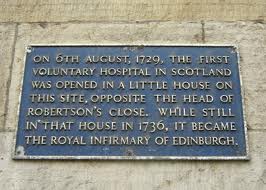
A good example of this was Edinburgh Royal Infirmary who on admission to the hospital, asked  patients for their "native place" or in other words, their place of birth.  This can be invaluable for those seeking to place their Irish ancestors as it would often name a town or at least a county.

It can often be a surprise to find ancestors admitted to hospital.  How did they afford to pay for their care if there was no free health care? However many hospitals were operated by subscriptions and were known as "free" or "voluntary" hospitals.  They received donations from rich individuals but also charities, churches and many work places and unions operated schemes where workers paid into a fund so that they could receive treatment if they needed it.  The work place contributions were particularly common within industries where there was a certain amount of danger and therefore there was more chance of accidents.

Hospitals were not always  in the immediate area in which your ancestors lived so if your relative died in hospital, you may find it is some distance from their home. This is usually because this was a hospital that was free or perhaps, the one to which their workplace or church subscribed.

It is important if you are going to approach a health archivist to be prepared.  They will need specific information on your ancestor in most cases.

They are not usually able to look for someone without details of when they were in the hospital as the information is not in a nice modern database where they can simply search for someone's name!

Also, think closely about what information you would like to find out.  The archivists will answer your questions but they cannot answer questions that you have not asked!  

If you would like further help or information on discovering heath records then contact us for a no obligation chat at: 

kintree@ymail.com

Click on the links below to find us on 
facebook                    twitter


Friday, 12 July 2013

Successfully Tracing And Contacting Relations

Kin Tree is often asked if we can search for descendants as well as ancestors. The answer is yes! 

The research itself is similar to looking for ancestors because what is important is to carry it out in a systematic way and have the knowledge to know where to access the information.

It  is  not  only direct  descendants  that people are interested  in finding but also  2nd, 3rd, 4th cousins  etc. People look for these relations for a variety of reasons. Occasionally it is for medical reasons but mostly it is simply to widen their family circle and find out what happened to other branches of the family.

What sometimes worries people is what reaction they will get to the initial contact that is made.  Most people are welcoming and interested themselves and the worst that is going to happen is that someone says they are not interested or doesn't reply.

The way in which you contact someone is very important.  The best way to get in touch is by mail.  This gives the person the time to think about what you are saying and how they want to respond.  If you phone them then they may be suspicious that you are trying to scam them and could brush you off. 


The important things to remember

  • Be specific about why you are getting in touch
  • Explain how you obtained their contact details
  • Give them multiple ways of contacting you so they can pick the one with which they are comfortable
  • Offer to share information with them
  • Be patient! Some people don't answer for a while


After you successfully contact and get a response from your relation then it can provide new information for you.  It is often one person in the family who inherits the old photos and documents and they are likely to be a rich source of information.  All great for filling in some blanks in your family tree!

If you would like help to search then please contact us for a no obligation free chat.

Contact us by email: kintree@ymail.com  

or click below to 


Friday, 5 July 2013

++Competition Result +Competition Result +Competition Result ++


Thank you to all who entered our competition!  The winner of the competition is 

Mr David Fraser of Lanarkshire  

David was a little camera shy so did not want his photo on our page however he was happy for us to share the details of his prize with everyone.


David is looking for information on some specific ancestors and so we will be spending the day check information in two archives for him.


Remember, you can contact Kin Tree with any queries you have on specific ancestors, not only to have a whole tree researched!

Contact us:  kintree@ymail.com

Facebook: www.facebook.com/kintree       

Friday, 31 May 2013

Should You Be So Quick To Dismiss The Possibility Of A Professional Family History Researcher?


If you are one of the many people who like to investigate their own family history or perhaps are thinking of investigating it, you might think that it is unlikely that you would not need a professional family history researcher.  


Should you be so quick to dismiss the possibility of a professional researcher?

Professional researchers can save you money on doing it yourself.  Looking at Scottish records, a basic online search of only three generations could easily cost you £100.  However, professional researchers can visit centres and do the work for you - and far more work - in a short time period and certainly for less cost per certificate than trying to do it online.  

Part of the fun for you, might be doing the research yourself, even if it takes much longer and is more costly.  However, have you ever hit a brick wall with your research?  Professional researchers such as Kin Tree have obtained nationally accredited qualifications and have a great deal of knowledge of other ways to find out information on your ancestors.  Getting over that brick wall could be all you need to get on with research yourself.  Why limit your family history interest because of a snag that could easily be remedied?

Professional researchers with properly accredited qualifications are used to dealing with archives and with so many records not online, they are ideally placed to visit on your behalf.  

Visiting an archive may not be practical for you or sometimes it can seem daunting but it every day business for the professional researcher.

Most people find ancestors have moved around - often to other parts of the world and it can be a difficult to navigate in other countries' records systems.  Also, like at home, many records will be offline.  Professional researchers are used to dealing with these record systems and have links with other professional researchers around the world who can look for offline records for you.

At a good professional research company like Kin Tree, our researchers have qualifications in both family history but also in history.  We have specialists in Scottish history along with more general history.  This is important to put your family story into context.  Once you have the basic dates, you will want to know how your family lived and perhaps what prompted them to move or do the type of work that they did.  We can all guess at this but with our knowledge of history and how it is properly researched, this can quickly be added to your family story in a way that it can take months if not years to do on your own.

So remember, it's important to think of every avenue for your family history research.  Don't limit your family's story because you didn't check out what help is available.  At Kin Tree, it is always free for you to have a chat.  Contact us for a free no obligation chat at 

kintree@ymail.com

Why not enter our competition to win some free research.  It's a great way to find out if a professional researcher can help you!

Click here to enter the competition 

Thursday, 4 April 2013

++++Ten Tops Tips +++Ten Tops Tips+++Ten Tops Tips +++Ten Tops Tips+++Ten Tops Tips +++Ten Tops Tips+++Ten Tops Tips +

Ten Tops Tips For Family History Research


1. Family Information 
Most families have access to some birth, marriage and death certificates so it is always a good place to start by asking relatives what information they have.  Families can also be a wealth of information on where people lived, their jobs and interests. These can all be keys to filling in your family's story. This is something that Kin Tree professional researchers will always encourage people to do.


2. What Do You Want To Find Out
Think about what you want to find out. Are you interested in birth, marriage or deaths, surname origins, places, occupations... Plan out how you will do this. You may find out that your interests widen as you find out information.  That's great but remember to add these new interests into your plans.  Kin Tree often find that people come to us for their family tree details but then ask us to research why a family might move or to give them more information on an occupation, a work place or the living conditions of the family.


3. One Branch At A Time
Image courtesy of franky242/FreeDigitalPhotos.net
Its not so good to try to do different parts of the family all at once.  It can be hard to not get confused with names, dates and places otherwise.  Whether doing research for one tree or like Kin Tree for a variety of families, its important to have files for each family and their branches.  Keep a note of where you get information.  It makes it much easier to go back and check if you need further information or to clarify anything. 


4. Keep Records Of Searches
Image courtesy of Keattikorn/FreeDigitalPhotos.net
Keep a note of what you are doing. Recently, for example, one of Kin Tree's researchers was at a Scotland's People Centre and came across a birth where the mother's maiden name was not the one expected.  Although our researcher was fairly sure it was a mistake, she took the time to check out these new details for this mother - birth certificate, census records and a marriage - to check if this was a different person.  No details of anyone with the unexpected maiden name were found but our researcher noted down the research carried out.  This prevents duplication.  It is easy to forget what might have been done when you look back some time later.


5. Family Stories
Family stories can be a great source of clues to the past but sometimes they are not accurate. Our researchers were asked to find the death certificate of someone who was originally from Scotland but who had died in the USA.  He was supposed to have died helping to build one of New York's iconic buildings. The family had hit a brick wall and called us in to help.  We checked USA records on the person but could find nothing for a death.  We decided to check the Scottish records and found his death in Scotland some 10 years after the building was finished.  


6. Archives
Many archives hold great information unavailable elsewhere.  Often though these are not online.  Archives will be indexed in different ways so if you don't find the information you are looking for, try to think of a different way of looking and you may be surprised at the results! Kin Tree have experience of accessing a wide range of archives so please get in touch if you need some help.


7. Write Down Your Thoughts
Have a notebook to jot down your thoughts as you go along.  This is great for when something pops into your head at a time when you are busy but you might forget later. It's especially useful when you are searching records and it makes you think of a follow up which might also be relevant to another branch of the family tree.  


8. Be Sensitive
Sometimes you will find out unexpected information which you may find fascinating however others may feel sensitive about what you have found.  Kin Tree would suggest that you talk to people about the information before putting it all down in a book.  Kin Tree would always pass on this information but never put it down in black and white without permission.


9. Looking To The Future
If you are attending a family event, record who was there along with the date and place.  Was there anything out of the ordinary - perhaps a wedding in a location with a significance to the couple etc? What might be known to you will not be known to future generations when your family history book is passed on.


10. Expert Help
Professional genealogists such as those at Kin Tree have a wealth of knowledge which can be very useful. Do you need help when you hit a brick wall or can't access an archive yourself? Would trawling through records cost too much? Kin Tree can help save you time and money as our expertise means we know what is possible and practical and are used to costing out research. We have studied not only genealogy but also history so we can provide a rounded service to give you an extensive picture of your family's story.


If you have any questions or enquiries, please contact us! 

You can contact us by email:  kintree@ymail.com