Showing posts with label Ireland. Show all posts

Friday, 2 May 2014

The Pros and Cons Of The New Online Northern Irish Records Search

In April, PRONI, the Public Record Office of Northern Ireland's launched an online search facility for Northern Irish BMDs.

There were hints beforehand that the site would be the same as Scotland's People but it has a different look and feel to it.  There are positives and negatives compared to Scotland's People but the important thing is that it now gives remote access to a whole array of Irish records to everyone who cannot visit Ireland.

What Records Are Available Online?
The facility is to search for Northern Ireland only and so covers the counties of Antrim, Armagh, Derry, Down, Fermanagh and Tyrone and includes -

  • All statutory birth, marriage and death records from 1864
  • Non-Catholic Marriage Indexes from 1845
  • World War II death registration 
  • Search and view townlands for Northern Ireland

The same rules apply as on Scotland's People's online records
  • birth registration over 100 years old
  • marriage registration over 75 years old
  • death registration over 50 years

How Does It Work?
Access the site online at https://geni.nidirect.gov.uk/

You will see that it tells you that you can search without registering and for free.  This is slightly misleading.

You can indeed do a free search but to look at the results of that search, you need to register for the site. However, given that you are there to look for records, it should not matter that you have to register.

You will also need to buy credits to look at the search results.  However, the biggest plus is that you can buy a credit for 40p and as long as you have one credit registered, you don't need to buy any more to search. The searches themselves are free so it won't use up this one credit to search.

Search Results
You will receive a list of basic results of your search and then it is up to you what amount of further detail, you require.
  • Basic Search Results - Sometimes it will be enough to look at the free search especially if you are only only wanting to confirm information. Certainly, we have found there is more information given than on a Scotland's People initial search. 
  • Enhanced option - This gives you a few more details of the record (costs 1 credit)
  • Full option - This will show a copy of the image along with a transcription (costs 5 credits)
  • Order Certificate  - You can also order a copy of the certificate.  You cannot use credits to do this and it will cost £8 for the certificate.  If you do decide to go down this route and are looking for a pre 1922 certificate then it will also be available from the GRO in the Republic of Ireland.  It is always keeping an eye on prices as it might work out cheaper to order from there. At the time of writing, prices there ranged from 4€ - 20€.

In our opinion, most of the time, it will be better to pay for the Full option as this will give you all the details available in the same way that the images on Scotland's People do.  It's worth trying different options though to see what you think.  As it only costs 1 credit to look at an enhanced image, it might be worth a try when you start so you get a feel for the information.  Remember first to click on the links above for full information on what the options will give you.


Using The  "Variant" Option
One of the options when putting the name into the search box is to use "variants".  We have not found this useful however.  Having already got several certificates in the past prior to this online facility, we used these in our initial free searches to test how useful the variant spellings feature was.

We put in the spelling from the certificates into the search boxes and it did bring us the correct results. However we did run into a problem.  Using "Ramsay" as an example - Altering one letter from Ramsay to Ramsey brought us results with only the new spelling we had entered so we did not see the record we had searched for initially using the spelling "Ramsay".  If you have used Scotland's People then you will know how useful the various options for alternative spellings can be.  Perhaps we have been unlucky (on several occasions) but we would advise that it is always worth manually trying all spelling variations if you don't come up with any results for which you are looking.

Credits
The biggest advantage over Scotland's People is that you can buy 1 credit only rather than having to buy 30 credits at a time as you have to on Scotland's People.  Also the initial searches don't cost you anything. Clearly there is a need to give them your card details which some people don't like however it is part and parcel of accessing information these days.

If there was one thing here that could make it easier, if you have not read through all the information prior to starting and buying credits, you will be unaware of how many credits that you will need to look at the information.  If you don't have enough credits then it simply tells you that you need to buy more but it would be simple to have added the extra information to explain how many credits you need to do a search or the cost of buying an enhanced or full index. Once again, it's worth checking the pages on the different types of indexes (linked above) to see what the costs are.  Even if you know at the moment, it will doubtless change over time.

Warning!
On the site, in the drop down menu under "features" you can view your saved searches however, it only saves your searches for 72hrs! Then you need to search and pay for the enhanced or full index  again!  It is the same for any notes that you make (also in the drop down menu under "features"). 

Remember therefore to make a record of the information or print it off!

Opening Up Results
This will help to open up information about your ancestors from Northern Ireland.  
If you need any further help with searching or would like information on researching you Irish ancestors - wherever they lived in Ireland - then please get in touch for a no obligation chat at kintree@ymail.com.

Please click on the links below to find us on 

facebook                    twitter


Friday, 30 August 2013

What Can Hospital Records Reveal About Your Ancestors?

Death certificates can reveal a tremendous amount of information about your ancestors but they need not be the final piece of the jigsaw.  If you are lucky then an obituary may appear or you may find a will but even without either of these things, there is a great way to look for further information.

If your ancestor died in hospital then it is worth investigating if there is a record of their hospital stay. Depending on the country in which you live there may be some restrictions on what you can access and how much time must have elapsed before you can access the records however it is always worth checking with the archivists for the latest information as data protection laws are often updated.  

So what information can you find? It will vary even within the same hospital - from the briefest of details perhaps regarding your ancestor's admission to hospital to full clinical notes or a post mortem.  The great news though is that even with the briefest of details, these can easily reveal some interesting facts and open up a new way to investigate a branch of your tree.

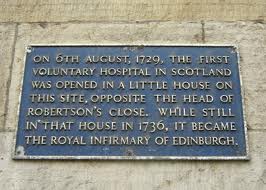
A good example of this was Edinburgh Royal Infirmary who on admission to the hospital, asked  patients for their "native place" or in other words, their place of birth.  This can be invaluable for those seeking to place their Irish ancestors as it would often name a town or at least a county.

It can often be a surprise to find ancestors admitted to hospital.  How did they afford to pay for their care if there was no free health care? However many hospitals were operated by subscriptions and were known as "free" or "voluntary" hospitals.  They received donations from rich individuals but also charities, churches and many work places and unions operated schemes where workers paid into a fund so that they could receive treatment if they needed it.  The work place contributions were particularly common within industries where there was a certain amount of danger and therefore there was more chance of accidents.

Hospitals were not always  in the immediate area in which your ancestors lived so if your relative died in hospital, you may find it is some distance from their home. This is usually because this was a hospital that was free or perhaps, the one to which their workplace or church subscribed.

It is important if you are going to approach a health archivist to be prepared.  They will need specific information on your ancestor in most cases.

They are not usually able to look for someone without details of when they were in the hospital as the information is not in a nice modern database where they can simply search for someone's name!

Also, think closely about what information you would like to find out.  The archivists will answer your questions but they cannot answer questions that you have not asked!  

If you would like further help or information on discovering heath records then contact us for a no obligation chat at: 

kintree@ymail.com

Click on the links below to find us on 
facebook                    twitter


Friday, 26 April 2013

Are Siblings Important To Family History Research?

Brothers and sisters can prove to be life long friends or alternatively squabble their whole lives but they may not seem a significant part of family history.

Research is generally aimed at looking at your direct ancestors so your relatives' brothers and sisters may seem of little importance.  They do play a vital role in your investigations however!


Image:debspoons www.FreeDigitalPhotos.net


Elderly relations often move in with their children and you may find that elusive ancestor residing with a sibling of your direct ancestor.  If this is a female then she may have married so if you get stuck with where an ancestor ended up, it is worth looking at what happens to other family members such as siblings and checking out possible marriage records.


If you hit a brick wall with your research, siblings can be a great way of trying to get over your genealogical barrier. Looking at the family history of a sibling might bring clues to your own direct ancestry. Often, one person inherits all the significant documents or photos in a family and by looking at other people who share some of your family history, you may find information that is important for you also.


Siblings can also help add to the family story.  Although not direct line ancestors to your family, they were the children of your ancestors so have a great significance to the lives that your ancestors led.  

Often migration for example, was to give their families a better life and it can be interesting to look at how people fared.  Circumstances can often change quickly for these people.  Lack of opportunity or education often meant poverty but  a change of country could open up previously unimaginable ways to improve their  situation.


At Kin Tree recently, we had a case where we unexpectedly discovered a whole new part of a family story as a result of looking at a sibling.  We had the death certificate for someone and noticed that the person who had registered the death was the son-in-law of the deceased.  We had no record of a daughter as we only had  sons showing up on census records.  

It turned out there was a daughter who had left home by the time that the family had moved to Scotland.. We found her marriage and her death certificates which confirmed her parents' names.  The family had originally come from Ireland and we were able to track down a birth certificate for her in Ireland which gave us a start on the family's Irish roots.  From that, we were able to trace back two more generations of the family, taking us back to around 1804.

For a free and friendly chat about your family history, email us at kintree@ymail.com